
I’ve been fortunate to visit Tabuk Castle (Tabuk Fort) many times over the past few years, and each visit has given me something new to appreciate. Walking through its ancient stone corridors, standing on its watchtowers, and exploring its small museum has always been a fascinating experience. As someone deeply interested in history, Islamic heritage, and cultural landmarks, this fort is truly one of my favourite places in Tabuk.
During my visits, I’ve captured exclusive photos of the castle, its surroundings, and nearby attractions, which I’ll be sharing throughout this post. My goal is to bring you an authentic guide — not just from research but also from my personal exploration of the fort and its history.
In this article, I’ll take you on a complete journey through Tabuk Castle’s historical significance, Islamic connections, cultural heritage, architectural beauty, and top nearby attractions. Whether you’re planning to visit Tabuk or simply want to learn more about this hidden gem of Saudi Arabia, this guide will provide everything you need to know.
 |
| Tabuk Castle An Ottoman Waystation, an Islamic Landmark, in Tabuk |
Why Tabuk Castle matters
In the very center of Tabuk stands a sandy-stone
fortress whose story threads together faith, travel, and trade. Known as Tabuk
Castle (or Tabuk Fort), the site guarded precious water sources for centuries
and welcomed Hajj caravans passing between the Levant and Madinah. Today the
castle is a restored museum and a serene courtyard space where you can read the
layers of local history on its walls—Arabic inscriptions, Ottoman-era tiles,
watchtowers, and the echo of travellers who once rested here on the long desert
road.
%20An%20Ottoman%20Waystation,%20an%20Islamic%20Landmark,%20and%20the%20Beating%20Heart%20of%20Tabuk.jpeg) |
| A Beautiful View of Tabuk fort from Othman Bin Affan Road |
the fort
Tabuk is inseparable from one of
the most compelling episodes in early Islamic history: the Prophet Muhammad’s
(PBUH) Expedition of Tabuk. Local memory and historical writing preserve how
the Prophet camped in the area, prayed here for several nights, and drank from
a spring later known as ʿAyn al-Sukkar (the “Sugar Spring”). A short
walk from the castle you’ll find Al-Tawbah Mosque (also called the
“Mosque of Repentance”), rebuilt in the 20th century but associated with that
prophetic stay. For many visitors, a tour of the fort naturally flows into
quiet moments at the mosque and a stop by the spring—three places that together
place the fort in its spiritual context.
Tabuk Castle (Tabuk Fort) – Islamic Heritage and Tourism in Saudi Arabia
.jpeg)
A fort built for the Hajj road—and still welcoming
travelers
The documented fort you see today
dates to the mid-16th century, when the Ottomans strengthened a chain of
waystations and castles on the Levant–Madinah Shāmī Hajj Route. Tabuk’s
fort protected a water station and served as a secure stop for pilgrims and
caravans. Over the centuries, patrons renewed and enlarged the structure:
inscriptions and records point to restorations under Mehmed IV in the
17th century and a comprehensive renovation under Abdülmecid I in the
19th century; the Saudi era brought further repairs in the mid-20th century and
again in the 1990s. In the 2010s, the site was modernized and curated as a
public museum. The continuity of care is striking: a place first known for
sheltering pilgrims now welcomes culture-seekers and families year-round.
%20%E2%80%93%20Islamic%20Heritage%20and%20Tourism%20in%20Saudi%20Arabia%20viral%20review%20pk.jpeg) |
| History of Tabuk Castle (Tabuk Fort) – Islamic Heritage and Tourism in Saudi Arabia |
What you’ll see: architecture
and ambience
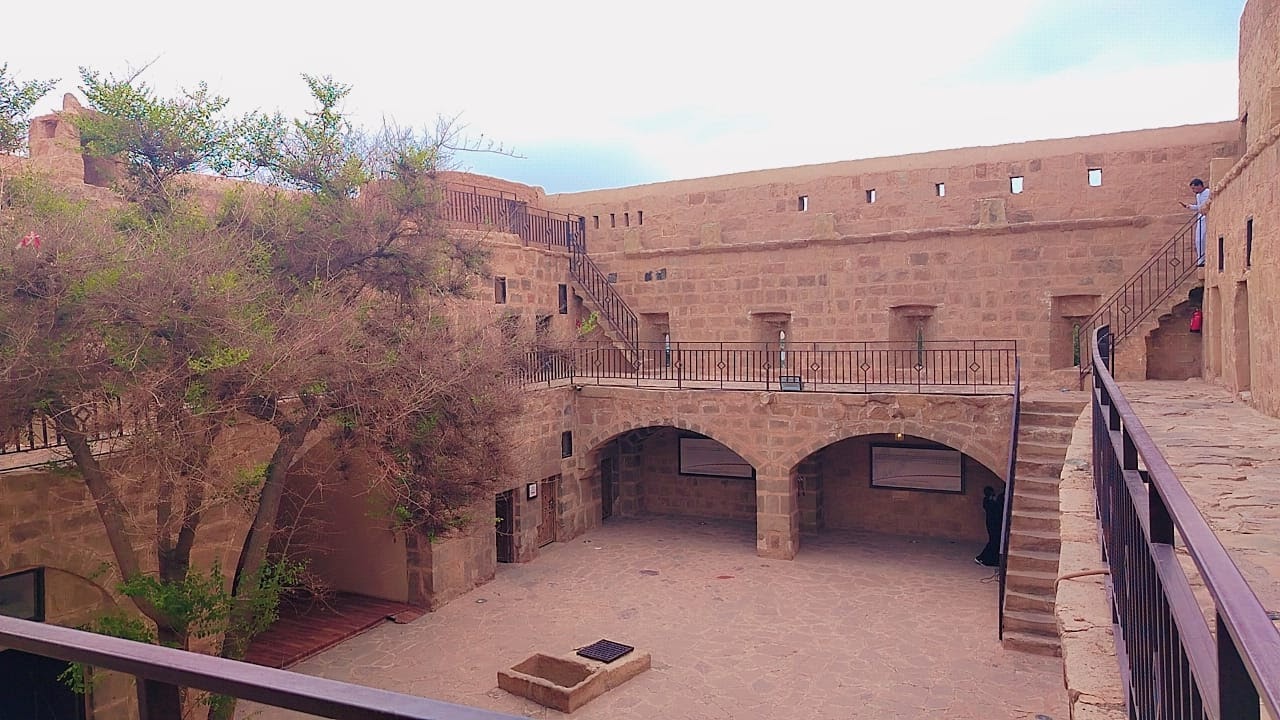
Two-level plan with a central
courtyard. Step through the arched northern entrance and the fort opens
onto a sunlit courtyard. Around you are domed or vaulted rooms that once stored
supplies, housed guards, and hosted travelers. Stairs climb to the upper
level, where you’ll find an open summer mosque and vantage points
along the walls and towers—a reminder that this was a lookout as much as a
lodging.
A small mosque—and a delicate
Ottoman touch. Inside, look for a mihrab inscription commemorating a
19th-century restoration and, near the entrance, decorative tiles added
during the 17th-century renewal. They’re modest, but they add a human warmth to
the sturdy stone.
Royal (Sultanic) pools.
Behind the castle are two carefully engineered water basins—one square,
one rectangular—that once helped regulate and store precious water for the
stopover. They underscore why Tabuk mattered: in the desert, water is strategy.
Arab
News
A museum that tells a regional
story. Exhibits change, but expect artifacts, photographs, and maps that
trace the Hajj road, local crafts, and daily life. The displays are digestible
and family-friendly; the fort’s intimate scale invites slow wandering rather
than checklist sightseeing.
 |
| Architecture and Ambience inside the Tabuk Castle |
The fort in its neighborhood: a heritage walk in the
heart of Tabuk
One of the joys of visiting Tabuk Castle is how much history
sits within a few minutes’ walk:
- Al-Tawbah
Mosque. The whitewashed mosque connected to the Prophet’s stay stands
nearby and has been renewed in modern times. Pause here after your fort
visit—it’s an easy, meaningful pairing. - ʿAyn
al-Sukkar (Sugar Spring). The oldest spring in Tabuk, associated in
local tradition with the Prophet’s camp, lies southwest of the fort. It
contextualizes the fort’s defensive role: whoever controlled the water
controlled the route. - Mud
House Museum (opposite the fort). Directly across from the castle, a
charming mud-brick heritage house showcases domestic life in
Tabuk—traditional rooms, tools, costumes, and hospitality. It’s small,
warm, and photogenic; many visitors say it’s the perfect complement to the
fort’s military architecture.
 |
| Mud House Museum opposite |
- Tabuk Hejaz Railway Station. A short drive away, this Ottoman railway
complex—once part of the famous Hejaz Railway—has been restored as a
heritage site and museum. Pairing the station with the fort gives you a “before
and after” view of how pilgrimage moved: camel caravan to steam engine.
%20viral%20review%20pk.jpeg) |
| Ayn al-Sukkar |
.jpeg)
Culture and continuity: crafts, food, and performance
Tabuk’s heritage is more than stone. Around the city you’ll come across Bedouin weaving, saddle-making, and coastal boat-building traditions—crafts documented by Saudi cultural institutions and kept alive in family workshops. Foods like jareesh, fatteh, and mansaf appear on local menus and in homes, while folk arts such as al-Dahiya (two facing rows clapping in call-and-response) animate weddings and festivals. If you visit during a weekend evening or holiday, you may hear the rabāba accompanying Nabati verse—poetry that once entertained these very caravan routes. Exploring the fort first helps these living traditions snap into historical focus.
 |
| Culture and continuity: crafts, food, and performance |
Top things to do at Tabuk Castle (and nearby)
- Climb
to the upper walkway for a wide view of the courtyard and towers;
imagine the watch duty as caravans approached from the north. - Study
the inscriptions—especially the mihrab text marking an Ottoman
restoration and any tiles by the entrance. - Visit
the Mud House Museum just opposite the gate to see how homes were
built and furnished in the region. - Walk
to Al-Tawbah Mosque and spend a few quiet minutes; the spiritual link
elevates the whole experience. - Add the Hejaz Railway Station to your itinerary for a complete heritage
morning or afternoon.
Planning your visit: practical tips
- Getting
there. The fortress sits on Al Amir Fahd bin Sultan Road in
central Tabuk; taxis and ride-hailing apps know it as “Tabuk Castle/Tabuk
Fort.” Parking is typically straightforward on weekdays. - When
to go. Tabuk’s winters are pleasantly cool, and spring/autumn
afternoons are ideal for the open-air courtyard; summer midday sun can be
intense, so aim for mornings or late afternoons. (Always carry water.) - Dress
& etiquette. As with any historic mosque precinct, dress modestly.
Photography is generally welcome in the fort; avoid flash in exhibition
rooms and be respectful when visiting Al-Tawbah Mosque. - How
long to allow. Most travelers spend 30–60 minutes inside the
fort, plus extra time for the Mud House and the mosque. Families with kids
often linger longer in the courtyard. - Tickets & hours. Hours can vary with seasons and holidays; check
official Visit Saudi / Ministry of Tourism listings or local signage on
the day you go.

Beyond the walls: day trips that echo the fort’s story
If Tabuk Castle whets your appetite for heritage and
landscapes, consider:
- Dhat
al-Hajj Fort (north of Tabuk): another Ottoman waystation on the
Levant Hajj road, with a square plan and reservoir—excellent for
understanding the network Tabuk anchored. - Wadi
Disah: a short drive south-east brings you to soaring sandstone
canyons and palms—a classic Tabuk day trip that pairs beautifully with a
morning at the fort. (Tourism pages for Tabuk frequently recommend this.) - Hejaz Railway stops farther along the line: for rail buffs, tracing
stations beyond Tabuk pieces together a dramatic early-20th-century chapter in
pilgrimage logistics.
 |
| Tabuk Fort Main Gate |
 |
| A Sign Board Out side the Fort |
Heritage in the Vision 2030 era: careful restoration,
open doors
Saudi cultural bodies have invested in
stabilizing and interpreting sites like Tabuk Castle so they can be safely
enjoyed by residents and visitors. In recent years, agencies refurbished the
fort and curated it as an archaeological museum, continuing a long
sequence of restorations (17th, 19th, 20th, and 21st centuries). The result is
a site that feels authentic without being fragile, and educational without
being didactic—a balance that makes it an exemplary family stop on any
Tabuk itinerary.
.jpeg)
Frequently asked questions (FAQ)
Is Tabuk Castle the same place mentioned in early Islamic
sources?
The castle you visit today is an Ottoman-period fortification tied to
the Shāmī Hajj Route. Its neighborhood—especially Al-Tawbah Mosque and ʿAyn
al-Sukkar—is closely associated in local history with the Prophet’s Tabuk
Expedition, which is why many visitors combine the three.
How old is the current structure?
The best-documented construction is 16th century (Ottoman). Later rulers
renewed it multiple times, and modern Saudi authorities restored and curated it
as a museum.
What’s the highlight inside?
Most people love the courtyard panorama from the upper level, the mihrab
inscription, and the juxtaposition of watchtowers with museum
rooms that bring caravan life to life.
Is it good for kids?
Yes. The compact layout, outdoor spaces, and simple exhibits make it easy for
families. Pair it with the Mud House Museum across the street for
hands-on heritage.
Can I pray at the fort?
There are mosque spaces within the fort and, more commonly, visitors pray at Al-Tawbah
Mosque nearby. Plan your timing around prayer times if you’d like to
include this in your visit.
 |
| Beautiful Mosques on Ground and 1st Floor inside the Tabuk Castle |
Final thoughts
Tabuk Castle is more than a photogenic fort in a
modern city—it’s a living crossroads. Its stones remember the faith-charged
march of the Tabuk Expedition, the slow rhythm of camel caravans on
the Hajj road, the steam-era transformation heralded by the Hejaz
Railway, and the renewed cultural energy of today’s Tabuk. Whether
you’re a pilgrim tracing sacred geography, a family looking for an educational
outing, or a traveler building a meaningful Saudi itinerary, the fort gives you
a crisp, walkable story you can see and feel in an hour—and ponder for much
longer.
Sources & further reading
- Visit
Saudi – official attraction page for Tabuk Archaeological Castle,
with overview and visitor information. - Saudipedia
– Tabuk city entry covering Al-Tawbah Mosque, ʿAyn al-Sukkar,
cultural crafts, and the castle’s role on the Hajj route. - IRCICA
/ Islamic Architectural Heritage – inventory note for Tabuk Castle
with construction and restoration dates. - Arab
News – “ThePlace: Tabuk Archaeological Castle,” summarizing
restorations, museum status, and the “royal pools.” - Wikipedia
– Tabuk Castle and Tabuk Hejaz Railway Station entries for orientation and
cross-checks; use alongside official sources.
.jpeg) |
| A beautiful single tree Inside the Castle |